Monday, November 29, 2010

The Perils of Globalized Life


August 17, 2010:

                You can arrive in Spain wishing that globalization was more complete and that Wal-Mart was on the scene “rationalizing” commercial life.  Not only are most businesses closed on Sundays but most close at two o’clock on weekday afternoons and re-open later only for several early evening hours.  In small towns and villages, groceries are sold at the neighborhood level almost literally from the ground floor front rooms of residences.  There is often almost no advertising clue that a house actually includes a shop.  When I push aside the ‘fly curtains’ of such a place, I’m gripped with this fear that I will find myself invading someone’s drawing room or kitchen.  My practice is to try to follow someone sporting a shopping hand bag.  I’ll blame any mistake on them. 
                But there is beauty in this “system”.  People walk to go shopping, getting exercise.  Since they must hand carry their consumables home, I swear that they eat both simpler and they eat less.  The “Superstore” parking lot facilitates both overconsumption and under exercise. 
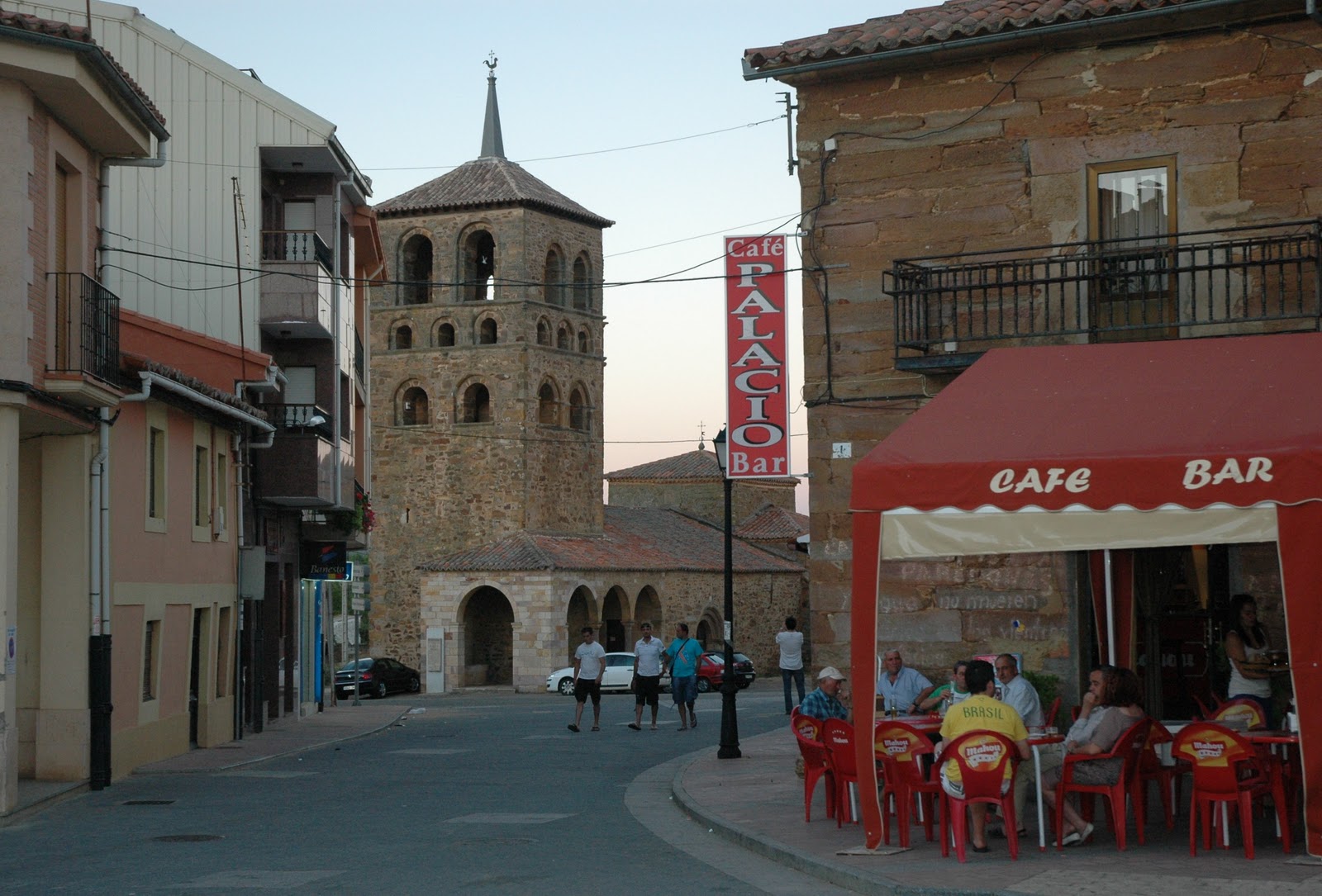
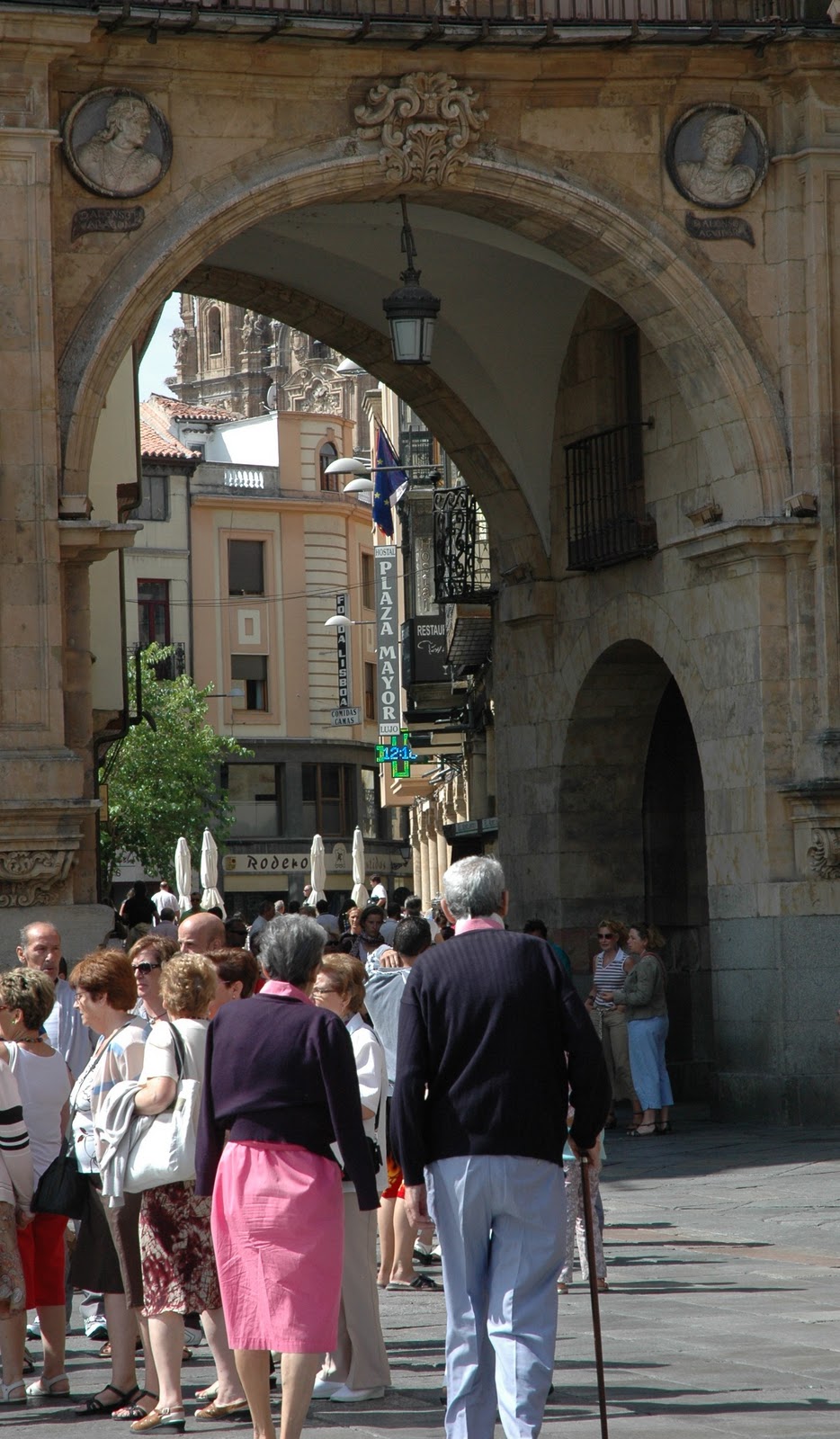
                I walked today into Villanueva de Campeán  (KM 567).  The Plaza Major in Salamanca, which can only be entered on foot, was fantastic.  I’ll reach Zamora, an old Roman town, tomorrow.

The Good Shepherd and His Dog


August 18, 2010:

                I slept in till 6:30 a.m. this morning in a quiet, other-than-by-me deserted private refugio in Villanueva de Campeán.  I still saw the last stars twinkle out and beat the sunrise by an hour.  Not long after, I noticed a mysterious dust cloud approaching.  At eventually close range, it proved to be one dog, one lonely shepherd on foot, and about 100 sheep on a Camino collision course with me.  A good sheep dog need not over police his flock.  With the dog ranging freely and widely in the countryside about them, the sheep need only know that the dog can be called quickly in the by Shepherd’s commanding whistle.  The Via de la Plata doesn’t just track ancient Roman silver mines road.  It also tracks livestock trails as legendary as the American Southwest’s Santa Fe Trail.  These famous drover roads classify as either Cañada Real, 50 meters wide, or Via Pecuria, narrower at only 25 meters in width.  Inside these trail margins, livestock were free to graze grass at will.  In the 1990s an effort was made to revive this tradition.  So my Shepherd was following ancient custom. 
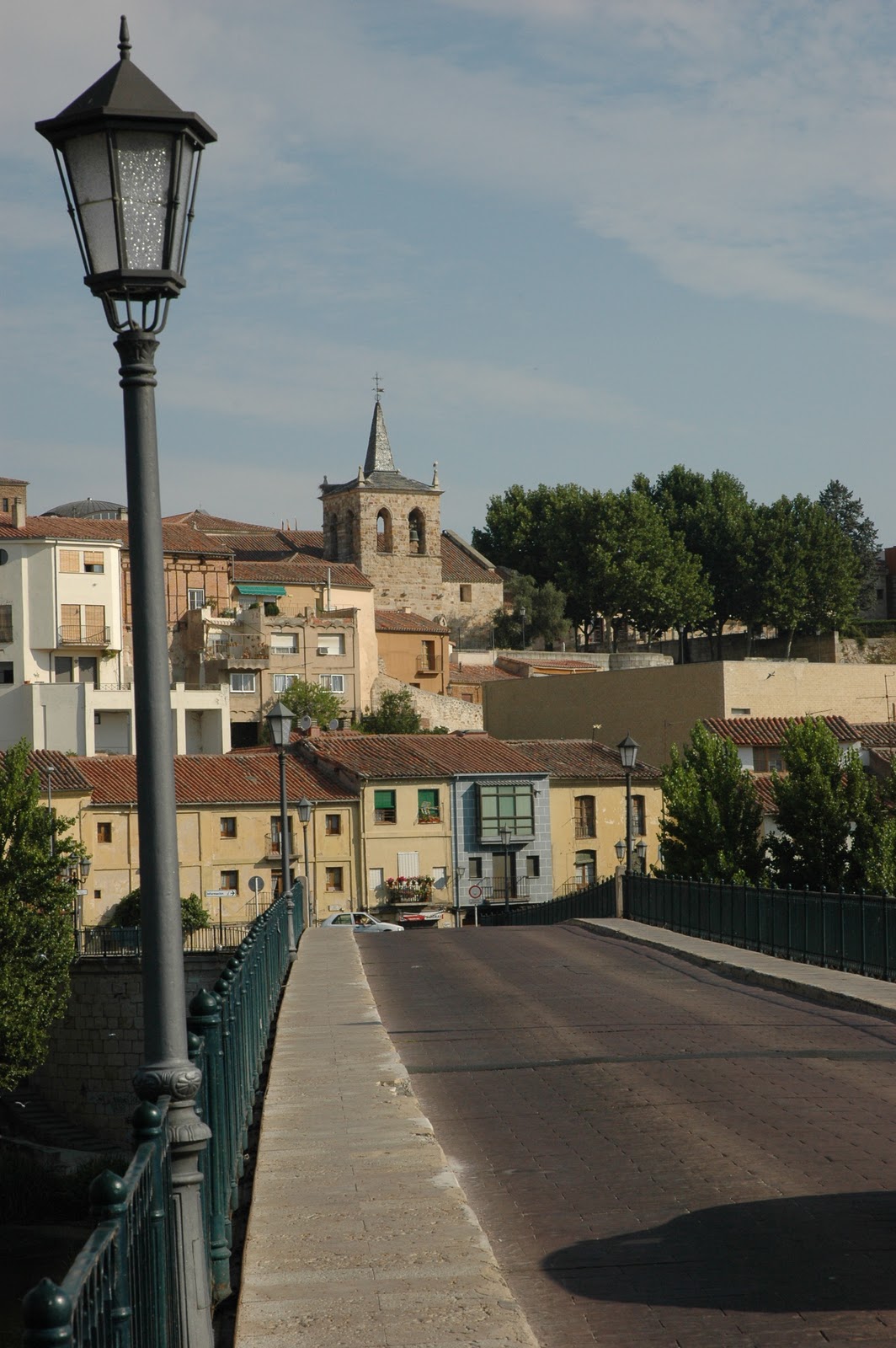
                I struck up a conversation with a man while crossing the ancient Roman Bridge into Zamora today.  Friendly, he eventually decided to dispense with directions and walk with me all the way to the Cathedral.  The city was great!  I’ve reached Montamarta (KM 605) tonight.

The Priest, the Pilgrim, and the Playwright

August 19, 2010:

                I’m in Granja de Moreruela (KM 627) tonight.  It’s significant because here the Via de la Plata divides, one route heading north for Astorga and concluding with a westward stretch on the Camino Francès, and the other route, mine, heading northwesterly into Galicia more directly to Santiago. 
I’ve been to Mass this evening and enjoyed it.  For no apparent reason, this small town’s 7 p.m. service drew the largest attending congregation I’ve seen this summer in Spain, I’m guessing easily 75 to 100 people.  There were more men than usual attending and they seemed to prefer as their domain the upper rear choir loft from where they could look down on their women.  The priest conducted the service expeditiously with no deacon, reader, or altar serving help.  Not a few parishioners have retired since down the street to a taberna.  My refugio is in this same air conditioned building so I have an excuse for joining them.  Pleasantly, the priest has dropped in for a little nip.  He hasn’t stayed long but I like that he enjoys the company of his “flock”. 
A Mass detail that I like is worth describing:  The priest consecrates a large “host”, breaks it, and then consumes only one small piece of it.  The other pieces he puts into the chalice and distributes with smaller consecrated hosts to communicants.  This sharing of bread is symbolically very appealing. 
I’ve been reading Henrik Ibsen plays as I walk, the last two of them being “The Lady from the Sea” and “An Enemy of the People”.  They can be worthy of Pilgrim meditation.  “Enemy” essentially concludes that “the strongest man is he who stands most alone”.  Interestingly, its lead Dr. Stockman character offered to illustrate this proposition, though prescient and far sighted, is a flawed, even weak figure, in other words, not doing so well standing heroically alone. 

Prayer and the Pilgrim Life


August 20, 2010:

                Zamora is a proud, provincial city that knows how its bread is buttered.  In its Plaza Major, one finds a fully plumbed in and operational central pivot, circle irrigation rig.  Several spans arc over stone cobbles and spray cooling water mist over delighted children and sun toasted pedestrians.  I’m in Tábara (KM 655) tonight, a smaller town with another noteworthy, revitalized central plaza.  It’s Friday night and lively after another hot mid day. 
                I’ve been to the 8 p.m. Mass in the parish church which fronts on the Tábara square.  Arriving early, I found twenty people reciting a vespers rosary.   A woman “calls” and fifteen women and four men “answer”.  It has the pacific thrum of chanting Tibetan monks.  Everyone knows their part and there is no hesitation and never a missed beat.  It’s like clockwork.  This concludes just seconds before the steeple bell rings, the priest enters the sacristy, and the mass begins.  The service is conducted by candle and sun setting natural light streaming in through stained glass windows.  The church is “La Asuncion”.
                This morning I walked across a beautiful arched bridge spanning the Rio Esla bringing me still closer to Galicia.  Minutes later I scaled river bank cliff up to where I could enjoy marvelous views of the surrounding country.

Things that Fall from the Sky

August 21, 2010:

                A tiny pueblito as good as dropped out of the sky for me this morning.  I’d left Tábara shortly after dawn at 6:30 a.m. under still waning star light.  For the second day in a row I found myself obstructed by massive landscape rearranging construction—bulldozers, earth haulers, trucks—it looked like the birth of a gigantic new super highway.  This dramatically disrupts way marking.  Oh Camino!  Where art thou? 
                My already dated guidebook was as good as useless but I seemed to guess right.  Yellow “fleche”/arrows reappeared and following them led me into Villanueva de las Perras, a town that I had no reason to expect.  I found a bar and sat down at its sidewalk tables to reorient myself.  A man appeared on the still morning quiet street and, proving himself the rare English speaker, asked me if I needed anything.  I said no but that I would have loved a cup of coffee had the bar been open.  He asked if I liked my coffee with cream and sugar and disappeared.  Returning shortly, he brought me a muffin and fresh brewed cup of coffee.  Before excusing himself (he had not yet had his own breakfast), he set me straight on my whereabouts and explained that the construction was the high speed rail infrastructure that will soon link together all major Spanish cities. 
                As I learned walking the Camino Francès in 2007, wind power generating turbines in long ridge line formations are common in the Spanish countryside.  This summer, I’m seeing them complemented by solar power generating panel arrays too and a postage stamp suggests that the Spanish are experimenting with ocean current driven water turbine electrical generation.  I’m in Olleros de Tera (KM 691) tonight.  Stumped for a refugio or food shop/restaurants in a town two kilometers to the south in late afternoon, three kids emerged to guide me here where I happily have both.  A young waitress who has served me at the Bar/Restaurant “La Trucha” has given me a new scallop shell with beautiful color for my neck lanyard.  I feel blessed.

Television and the Toreador

August 22, 2010:

                Let me assure you.  Bullfighting is up close, intimate, and vividly realistic on a giant, flat screened TV.  Here in Mombuey (KM 712) it provides the Sunday evening entertainment at the Bar San Martin just down the street from my Pilgrim’s refugio.  The refugio’s denizens tonight include four bicyclists and me, all of us male.  These proportions are quite representative of the August Via de la Plata.  I am always outnumbered by the cyclists and female pilgrims on the summer silver road are a rarity.  Happily this picture changes for me as my pilgrim friend AJ arrives to meet me by rail from Madrid.   I walk 33 kilometers to Puebla de Sanabria during the day tomorrow to meet her middle-of-the-night inbound train. 
                My guidebook promises that the character of our walking landscape changes beginning tomorrow becoming “Galician”—rugged and mountainous.  With pass elevations reaching 1329 meters (4,359 feet), some respite from the heat and even a little rain is a prospect.  One of my companions tonight is a Stockholm born Swedish cyclist.  He speaks English well and Spanish perfectly.  He learned it in the home as both of his parents are from Spain. 
                The only shade I’ve enjoyed on many recent days has been under “Encina”, or Holm Oak, an unusual “evergreen” variety that does not shed its leaves.  As conditions moderate, the Encina forest grows bigger.

Keeping the Pilgrim's Promise


August 23, 2010:

                Leaving Seville on the last day of July, I was by no means confident that I could walk the 745 kilometers from there to Puebla de Sanabria in the twenty four days before a train would be delivering AJ there to meet me.  I wasn’t even confident that I could survive any significant walking in above 35C degree southern Spain heat.  But here I am right on schedule.  I have walked an average of 31 kilometers (19 miles) for twenty four straight days with no rest.  I even walked a 48 kilometer day.  These numbers are far beyond any of my previous efforts.  Along the way, I even saw the 44C degree flashing temperature sign in Casar de Cáceres.  That’s a scorching 111 degrees Fahrenheit. 
                All the wheat cropland that I’ve seen since leaving Seville has been already harvested.  This puts that operation far ahead of what I used to see as a young attorney practicing in Eastern Oregon where harvesting peaked in mid to late August.  Here in Spain all I’ve seen is wheat stubble, in some cases with straw still to be bailed for livestock fodder.  From the beginning in Andalucía, I’ve also walked past hundreds of acres of sunflower with stalks already a crisp brown and the seeded heads black.  Since Zamora with conditions becoming more temperate, green has been returning to the landscape and I’ve even seen green stalked sunflower with yellow heads not yet ripe.
                I meet AJ at the train station at 3 a.m. tomorrow.  The good news includes that this is a beautiful, historic mountain town in which we can take a rest day.  And we have plenty of time for a more leisurely walk into Santiago from here.

Sneaking Through the Night

August 24, 2010:

                AJ described the experience as “sneaking through the night”.  She was referring to the quiet train that brought her gliding rail into Pueblo de Sanabria at 3:14 a.m. this morning.  Never mind the 33 kilometer walking day that I had completed just hours earlier, I met her on the station platform where she emerged the only train disembarking passenger.  Today we have slept and just explored this hill side castle fortress town. 
Isak, our evening dinner meal waiter, has been memorable.  A young policeman on holiday from anti Basque terrorist detail, he was moonlighting working tables for his resort town restaurateur uncle.  He owns three dogs and loves them.  This fall he will travel to California where he will study to become a “Dog Whisperer” animal trainer.  His English was experimental and halting.  But he was pleased when I told him that he could speak his Spanish to about a third of the residents of our Golden Gate state.

Finding the Real Camino


August 25, 2010: 

                AJ and I were rescued this morning by a kindly man out walking brush country with his German shepherd dog.  He redirected us off of a “Camino Real” diversion that we had mistaken for our Pilgrim way.  Later, we chanced upon him and his friends in a taberna where we had stopped for a fortifying Café con Leche.
                We have reached Requejo de Sanabria (KM 757) tonight, with its hill slope refugio open but empty.  It has beautiful San Lorenzo church surrounded by well cared for graves.  You can climb into its bell tower on an open, exterior wall stairway.  The town, though bisected by a highway, is quiet.  The world passes it by on a Wednesday on a nearby autopista main road.  Its Bar-Tienda Bañao restaurant makes a pleasant afternoon oasis. 

Patriarchs and Their Progeny


August 26, 2010:

                The branch route of the Via de la Plata that crosses through Galicia has its own tradition and name, the “Camino Sanabres”.  In truth, today’s walking has been the most pleasant of my Spanish summer.  AJ and I spent the morning in the cool shade of canopying forest before climbing up and over the 1,329 meter “Portillo de Padornelo” mountain pass.  The forest was mostly Holm Oak but a treat was giant Chestnut patriarchs and plantations of their smaller, well tended offspring.  In the tiny mountain village of Aciberos, AJ charmed a woman into trying to start up for us a small water powered flour grinding mill.  The skirted woman clambered up on its antiquated works clearing debris from its brush clogged mill race to no avail.  With elevation, temperatures have moderated delightfully.  We’ve reached Lubián (KM 778) with its municipal refugio being the first building that you encounter at the edge of the small mountain town. 
        

The Pueblo of the Perro


August 27, 2010:

                Jurgen, a cruising 40km/day German who caught us in Requejo has left us far behind.  In high country today, we walked through a tiny pueblo that had far more canine residents than human.  We’ve reached A Gudiña (KM 802) this evening, an industrial provincial center with its refugio on “the other side of the railroad tracks”.  While having a nice evening dinner at the “Bar Peregrino”, we watched men at work out the window moving round bailed hay with a tractor.

Police Protected in Laza

August 28, 2010:

                A leisurely sidewalk lunch we enjoyed today at the “Bar Rosario” in Campobecerros was interrupted when a shepherd drove his sheep past us up the hamlet’s tiny cobbled, main street.   In hot afternoon temperatures, we descended through dry Pine forest to reach river valley Laza (KM 836).  The municipal refugio here is modern and administered from the Police station where you register for the night and receive a room key.  We’ve had a delightful, home cooked meal this evening in the company of Dutch pilgrims Herman and Ella Sterenborg in the attic loft above the “Bar Picota”.